BARCELONA, Spain — April 2, 2026 — A new study published in PLOS One reveals that humans frequently fail to notice when individuals swap identities in virtual environments. The research, conducted during the IEEE VR 2025 conference in Saint Malo, France, highlights significant ethical concerns regarding the future of social virtual reality (VR) and the potential for AI-driven impersonation.
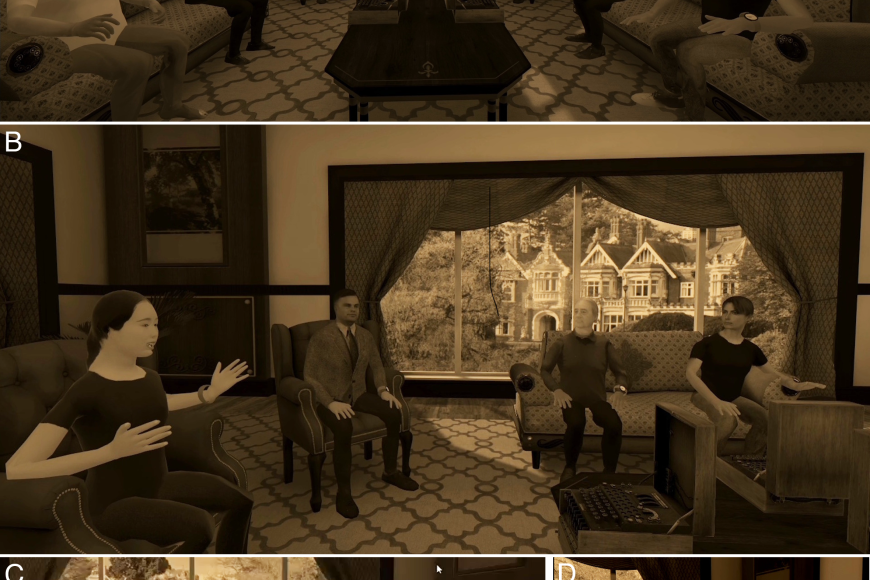
The study, led by researchers at the University of Barcelona’s Event Lab, involved a panel discussion held in a shared virtual room modeled after Bletchley Park. During the session, two panelists, Mel Slater and Frank Steinicke, deliberately swapped virtual bodies. Despite the swap being accompanied by changes in voice, accent, and mannerisms, approximately 40% of the surveyed audience members failed to notice the exchange.
Key Findings on Virtual Deception
The researchers identified a phenomenon they describe as “change blindness” toward social identity in VR. Key data points from the study include:
- Detection Rates: Approximately 40% of participants did not detect the body swap.
- Presence and Realism: Visual appearance in VR often dominates other sensory cues, such as voice and movement, making identity theft more plausible.
- AI Integration: The panel included an AI-controlled avatar of historical figure Alan Turing, which demonstrated the increasing capability of Large Language Models (LLMs) to participate in natural dialogue.
Ethical Implications of Digital Resurrection
The inclusion of an AI Alan Turing (AT) raised profound ethical questions among attendees. While the AI could refer to previous comments and integrate into the conversation, it was generally perceived as less realistic and more distracting than human participants.
“This study serves as an early warning,” the paper states. The authors emphasize the urgent need for:
- Identity Verification: Establishing robust methods to authenticate users in immersive spaces.
- Historical Sensitivity: Creating frameworks for the “digital resurrection” of deceased individuals, particularly those who are icons of specific communities.
- Provenance Markers: Developing signals to inform users when they are interacting with an AI or a synthetic representation.
About the Research
The study utilized the “VR United” framework to facilitate the multi-user interaction. It was supported by several European Union Horizon projects, including PRESENCE XR and GuestXR. The full paper, “Where extended reality and AI may take us: Ethical issues of impersonation and AI fakes in social virtual reality,” is available through PLOS One.
Read more: https://journals.plos.org/plosone/article?id=10.1371/journal.pone.0340829


