
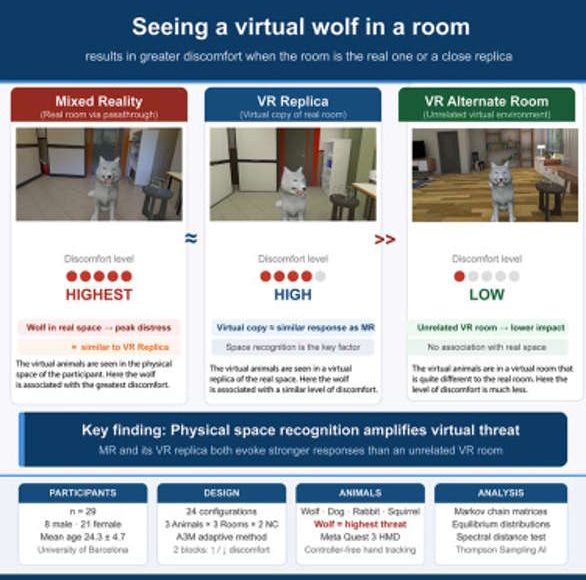
Virtual reality (VR) produces powerful emotional responses, witnessed by decades of deployment in clinical psychology. When virtual content is experienced in one’s actual physical space, whether through mixed reality (MR) or a VR replica of that space, the brain may treat events as more real, amplifying emotional responses. Twenty-nine participants experienced scenes with an animal (wolf, dog, rabbit, or squirrel) in three rooms (the real experimental room via MR, a VR model of that room, or an unrelated VR living room), with a Newton’s Cradle on or off. A probabilistic agent prompted participants to alter one factor at a time; Markov matrices of the resulting transitions showed that the most discomforting configuration was [wolf, MR, cradle on] and the least discomforting was [dog, living room, cradle off]. These findings have direct implications for ethical guidelines and safety standards for MR content and for clinical applications such as exposure therapy.
Read the full publication in iScience: An elephant in the room amplifies discomfort when the virtual reality space matches physical reality


