
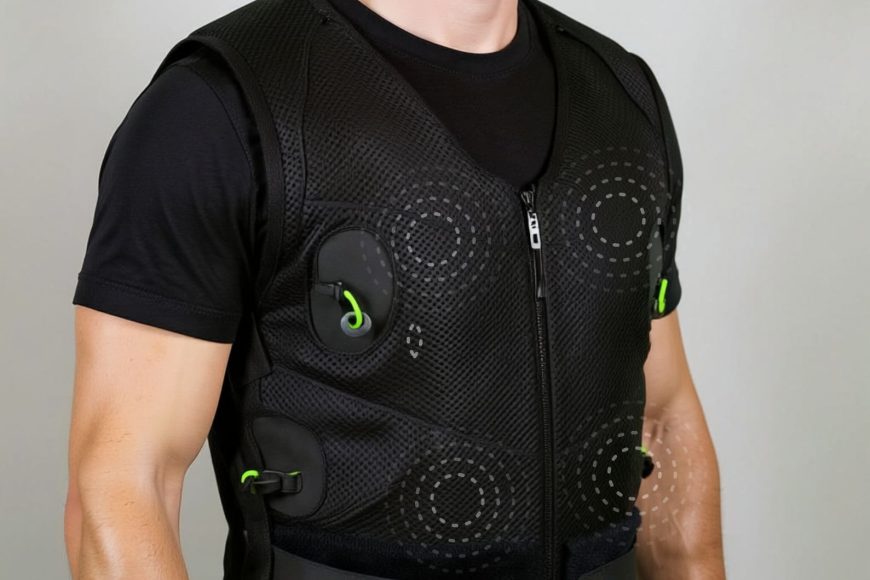
Touch is the sense we notice least and miss the most. It’s how we know someone is really there, whether that someone is a person in the room or an avatar in a virtual one. Within the PRESENCE consortium, Elitac Wearables set out to bring that sense of touch into digital interaction, starting not from a blank page but from a partner’s innovation: the Razer Freyja haptic cushion, whose vibration-based feedback we set out to translate from something you sit on into something you wear.
A Different Kind of Contact
The Razer Freyja haptic cushion had already proven that vibration-based haptic feedback could feel natural and intuitive, but a cushion and a vest are two very different bodies of work. Sit in a chair and gravity does the hard part for you, pressing you evenly into the cushion. Wear a vest and everything changes: you move, you breathe, the fabric shifts, and contact force with the skin becomes unpredictable. Translating the actuators of the Razer Freyja haptic cushion from a seat into a garment meant rethinking the physics of touch from the ground up.
So that’s where we started: research. We studied the actuators of the Razer Freyja haptic cushion in detail: how much pressure the body needs to register a clear vibration, which locations on the torso respond best, and which materials and integration methods hold up against movement without dulling the sensation. The goal was simple to state and hard to achieve: create vibration-based touch that feels just as clear and comfortable in a moving vest as it did in a stationary cushion.
Designing Around the Body, Not Just the Idea
In parallel, we teamed up with our consortium partners on the software side, developing and fine-tuning the vibration patterns that give each signal meaning. Hardware and software pushed each other forward rather than just falling into line: the actuators needed to sit exactly where the patterns expected them, and the patterns needed to draw out everything the actuators could deliver. Neither side was optimized in isolation, and that’s what made the final feedback feel sharper than either could have achieved on its own.
Turning Research Into a Wearable
As both tracks converged, our team designed the textile patterns, actuator landing spots, and protective casings that let the technology disappear into the garment rather than sit on top of it. Once the first prototype came together, we put it in front of the people who mattered most: our project partners, testing and giving feedback in real sessions. That feedback shaped the next round of improvements, both to the vest itself and to the experience of wearing it.
Once the design held up, we sourced final materials and components and built a small series of six haptic vests for pilot testing across PRESENCE’s use cases, moving the project from lab prototype to something real people could try on.
Adding a New Dimension to Digital Interaction
Today, that vest is doing exactly what it was designed to do: turning digital interactions into carefully choreographed vibration patterns that add a physical layer to virtual experience. It’s a small technical leap with an outsized effect, bringing users a step closer to actually feeling the digital world around them, not just seeing or hearing it.
Built for More Than the Lab
None of this was built purely as a research exercise. At every stage, from material choice to how the actuators are integrated, we made decisions with manufacturability and scale in mind. That’s the part of the work that doesn’t show up in a demo but matters most afterward: a haptic vest that performs in a pilot study and is also ready to move toward commercial production. It’s a good example of what we do at Elitac Wearables, turning complex sensor, electronics, and smart textile challenges into wearable technology that’s genuinely ready for the real world.


