Extended Reality is changing how we interact with digital content. Yet VR sickness remains a challenge in making it comfortable.
Complaints about stereoscopic discomfort are not new. When Sir Charles Wheatstone introduced the stereoscope in 1838, and later when Brewster stereoscopes became popular during the Victorian era, viewers quickly learned that misaligned images or unnatural viewing geometries caused eye strain, headaches, and visual fatigue.
VR sickness remains difficult to combat because it has so many different culprits. The way we move through, interact with, and display the virtual world plays a role alongside hardware factors such as input lag, low refresh rates, motion-to-photon latency, and poor head tracking. At RAYTRIX, we recently experienced this problem firsthand when we had two identical headsets in our office. One was comfortable to wear, while the other reliably caused VR sickness after about 10 to 15 minutes, depending on the user. From the outside, they were identical, yet the negative experience with the second headset was consistent among all testers.
So, what happened when we turned the light field XR capturer invert and let it look into the device?
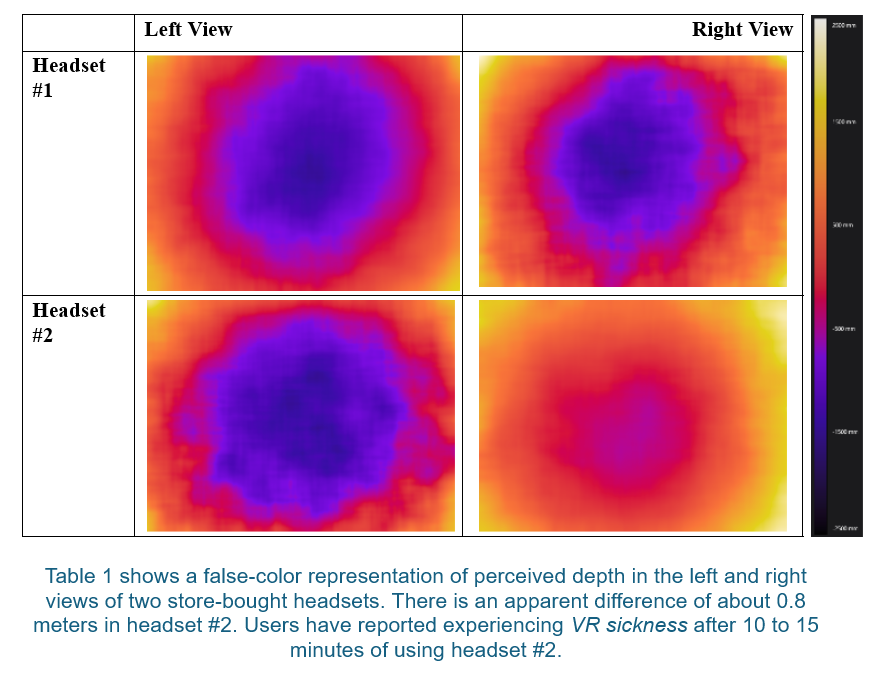
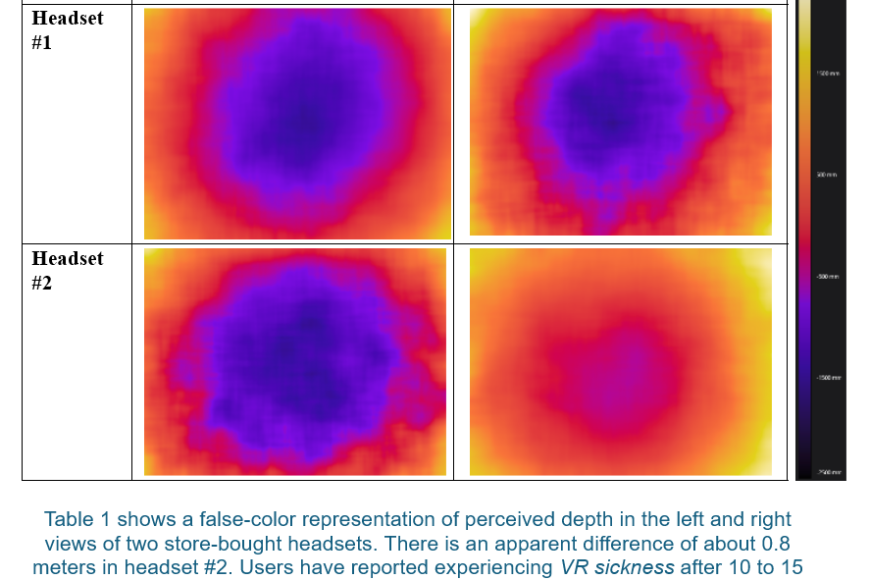
By analyzing a single light-field image captured inside the headsets, the cause of the nausea became visible. The perceived depth of the left and right views was consistent in the comfortable headset but diverged by 0.8 meters in the other.
When the optics and screens are slightly misaligned, the user’s eyes and brain are forced to compensate constantly. Because the human eyes are neurologically wired to focus together, they cannot simultaneously accommodate two different depths. This forces the visual system into a constant tug-of-war, tearing at the vergence-accommodation linkage. This interocular mismatch is a documented cause of severe visual fatigue and nausea. So, this slight manufacturing inconsistency proved to be the difference between a good time and a headache.
While revealing this depth mismatch solved the mystery of our second headset, the technology’s application for quality control extends much further. Because a light field system captures spatial and angular data simultaneously, it serves as a capable solid-state inspection tool that goes well beyond basic depth perception. The same single light-field image can be used to measure the optical wavefront and determine perceived sharpness. It finds defect pixels and spots, inclusions, dust, or particles in or around the lenses. Thanks to the inherent 3D data, the system can determine exactly where and what a defect is. By its very nature, a light-field system can synthetically replicate the optics of the human eye, enabling it to simulate eye movement from a single instantaneous snapshot.
In a previous post, we explored how light-field cameras, based on a concept first theorized over a century ago, have become a viable modern solution for capturing volumetric data. Now, this historic light-field approach is being used to investigate the equally ancient problem of stereoscopic discomfort.