PRESENCE: the European project redefining the future of XR
Within the landscape of European innovation, PRESENCE stands out as one of the most ambitious projects dedicated to transforming immersive experiences. Its goal is simple to describe yet extremely complex to achieve: bringing the feeling of “truly being there” in virtual environments to a level never reached before.
To accomplish this, the project combines advanced research and emerging technologies in three key directions: hyper-realistic XR interactions, high-fidelity holoportation, and haptic systems capable of reproducing the sense of touch. Added to this is the development of believable virtual humans, avatars, and digital agents able to sustain natural conversations and behaviors.
The expected outcome is a more human, more sensory, and more effective XR ecosystem, designed to revolutionize sectors such as professional training, remote collaboration, the creative industry, and industrial applications.
Why Virtual Reality is transforming industrial training
In recent years, technical training in the industrial sector has undergone a profound transformation. The increasing complexity of machinery, the need to reduce downtime, and the urgency of ensuring ever-higher safety standards have pushed many companies to rethink their training models. In this context, Virtual Reality (VR) is emerging as one of the most effective and versatile tools for preparing operators, technicians, and maintenance personnel.
Training accessible from anywhere
One of the most evident advantages of VR is the ability to train people wherever they are, without requiring travel or physical presence. This makes it possible to:
- involve internationally distributed teams
- reduce travel costs and time
- accelerate onboarding for new operators
Training becomes scalable and immediately available, regardless of participants’ geographical location.
Total safety in a controlled environment
VR makes it possible to simulate complex, risky, or hard-to-replicate real-world scenarios, ensuring safe and progressive learning. Operators can:
- practice critical procedures with zero risk
- learn how to manage emergencies or anomalies
- build confidence before working on real machinery
This approach drastically reduces accidents, errors, and supervision time.
Cost reduction and production continuity
Training personnel on real machinery often requires downtime, material consumption, and the use of technical resources. With VR:
- training takes place on digital replicas of machines, without interrupting production
- no materials or components are consumed
- logistics and equipment-availability costs are reduced
The result is a more efficient, sustainable, and easily replicable training model.
Repeatability and standardization
VR enables the creation of perfectly repeatable training paths, ensuring that every operator receives the same level of instruction. This leads to:
- greater uniformity of skills
- objective performance evaluations
- the ability to monitor progress over time
Standardization becomes a competitive advantage, especially in regulated or highly complex environments.
Advanced technologies integrated into the experience
Haptic gloves: touch enters virtual training
Integrating haptic gloves brings VR training to a higher level, introducing tactile perception and realistic object manipulation. Key benefits include:
- physical feedback when handling levers, buttons, tools, or components
- greater precision in technical gestures thanks to simulated resistance
- faster learning through sensory engagement
- fewer errors when transitioning from virtual to real tasks
This technology makes the experience more immersive and allows operators to practice delicate operations with impressive realism.
Holoportation: real-time remote presence
Holoportation brings the three-dimensional presence of a remote expert into the virtual world, as if they were physically next to the operator. The advantages are significant:
- real-time support from specialists located anywhere in the world
- the ability to guide, correct, and demonstrate complex procedures
- immersive collaboration without travel costs
- greater effectiveness in advanced training or problem-solving
It is a technology that eliminates distance and makes knowledge instantly shareable.
Artificial Intelligence: a tutor always present
AI integrated into the simulation plays a fundamental role in making training more effective and personalized. Its functions include:
- step-by-step explanation of procedures
- monitoring user actions and highlighting errors
- dynamic adjustment of difficulty levels
- providing data, suggestions, and contextual information
- automatic performance evaluation
AI becomes a true virtual assistant, capable of guiding the operator and ensuring continuous, measurable learning.
The role of Vection Technologies
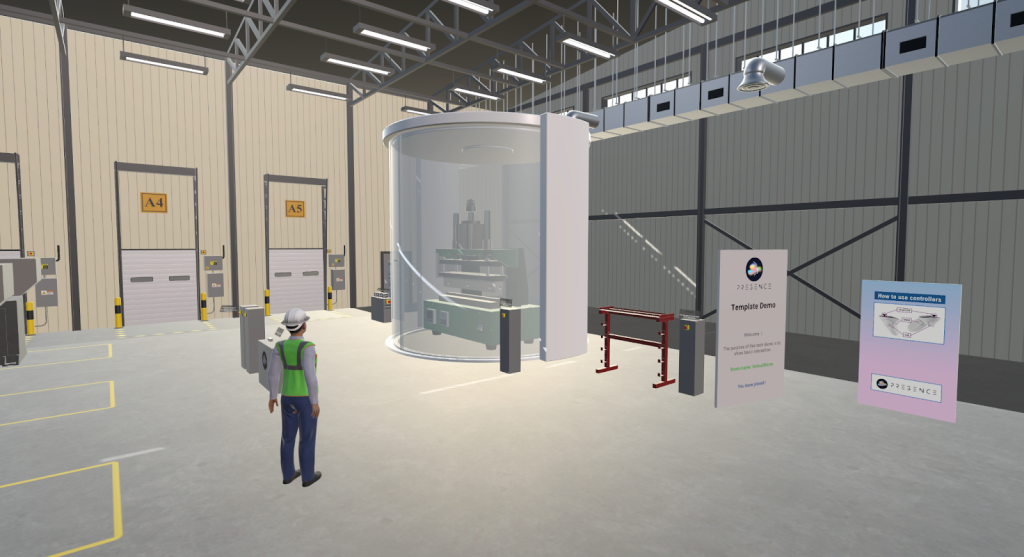
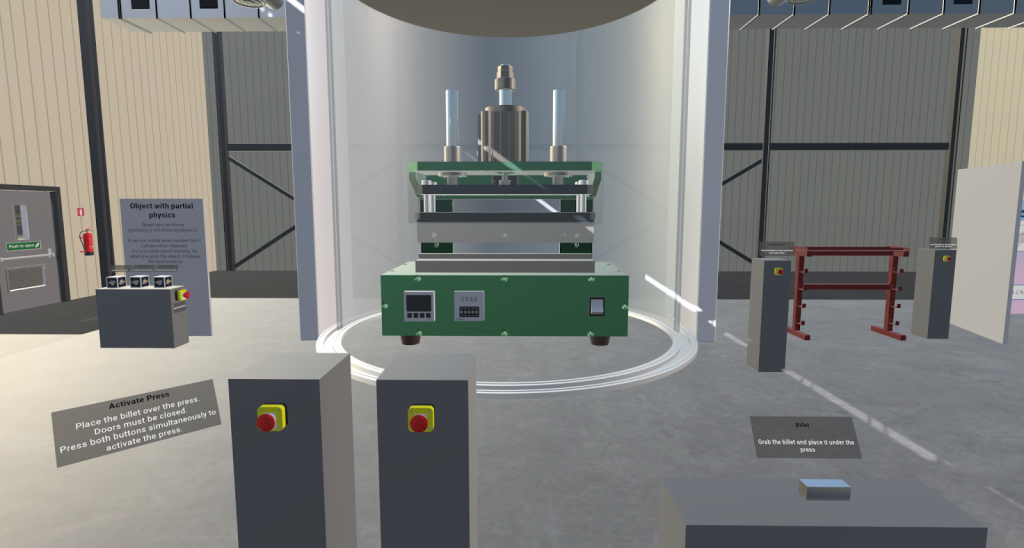
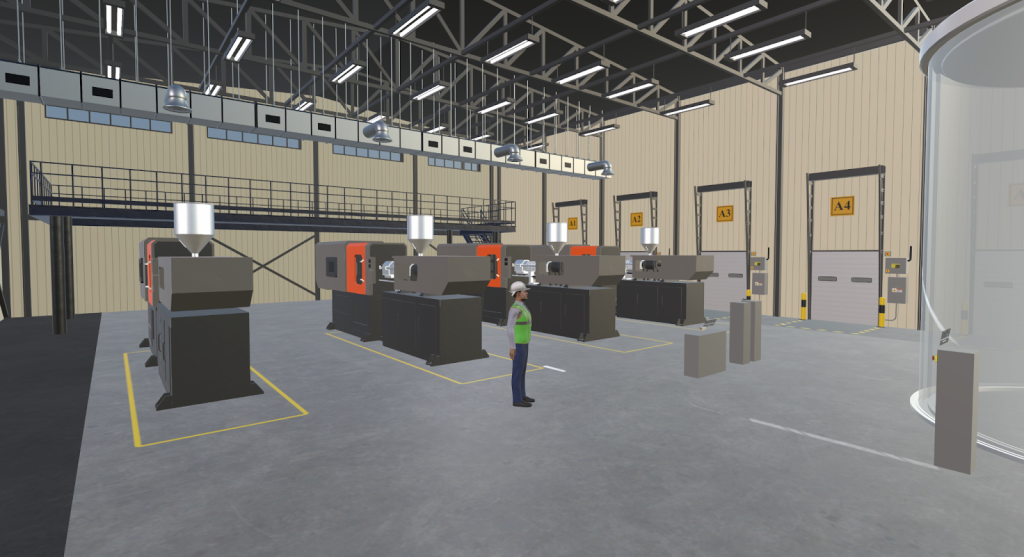
Within the PRESENCE project, Vection Technologies contributes its expertise in immersive solutions to create one of the consortium’s most representative use cases. The company is responsible for developing a multi-user VR environment dedicated to training on the use of an industrial press—a complex machine requiring precision, coordination, and maximum safety.
Thanks to realistic simulation, real-time collaboration, and the integration of advanced technologies such as haptic feedback and guided assistance, the scenario developed by Vection enables operators to learn critical procedures without risks, reducing training time and increasing skill quality. This use case clearly demonstrates how VR can transform industrial training, making it more effective, accessible, and safe.
Conclusion
The combination of Virtual Reality, haptic gloves, holoportation, and Artificial Intelligence represents one of the most significant evolutions in modern industrial training. This technological ecosystem enables the creation of safer, more cost-effective, accessible, and engaging training paths, capable of preparing operators for the challenges of contemporary production without interrupting real processes.
If the goal is to increase skills, efficiency, and safety, immersive training is no longer a futuristic option: it is a concrete solution, already available and ready to scale.
PRESENCE aims not only to improve technology, but to redefine the way we live, communicate, and work through digital innovation.