At ZAUBAR we think history should be experienced, not only explained. As part of the EU PRESENCE project, our Tunnel 57 demonstrator places people inside one of the most daring Cold War escape stories, using immersive visuals, tactile feedback and lifelike virtual witnesses. To move the project from prototype toward real world readiness, we ran a focused hands on test during Vision Xperience, hosted at hubraum, the Deutsche Telekom accelerator. This blog is relevant for cultural institutions, museum decision-makers and educators looking for more immersive ways to communicate history, as well as for XR developers, researchers and operational teams interested in how PRESENCE components perform in a real public demo setting.
Why we tested at Vision Xperience
Vision Xperience is a meetup series that pairs discussion of history, culture and artificial intelligence with hands-on demos, so the event audience was already primed to engage with cultural XR. The programme and talks made the PRESENCE use case a natural fit, and the cultural setting encouraged people to try Tunnel 57 for themselves. Our aims were straightforward: check that storytelling, interaction flow and hardware work together in a semi-public environment, gather immediate user impressions of immersion and emotional impact, and validate onboarding and haptic interactions before larger public demonstrations.
About Tunnel 57
Tunnel 57 reconstructs a real escape under the Berlin Wall that took place in October 1964. Visitors enter a confined, photorealistic reconstruction of the 145 metre tunnel, a space that was roughly 90 centimetres high and 60 centimetres wide. The experience combines reconstructed environments, archival media and first person testimony to put people in the physical and emotional conditions of the escape. In the demo participants crawl, crouch and perform simple actions such as digging or pumping, while virtual eyewitnesses share memories and context. The design is deliberate about emotional care: the goal is empathetic engagement that respects the historical reality.
Test format and setup
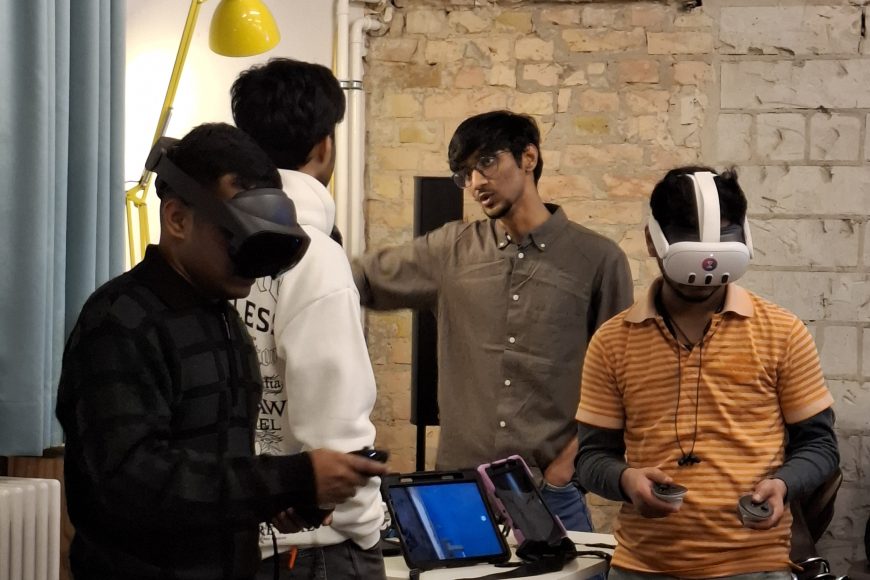
The session took place on 24 February 2026 at hubraum, Berlin and was offered as an optional part of the main event. 15 people tried the Tunnel 57 demo during the meetup, and many more attended the event generally. The format was kept compact to fit the meetup: a short briefing, a guided hands on session in VR, and a quick debriefing conversation to capture immediate impressions. We propped iPads beside demo stations so bystanders could see what participants were seeing, and our team helped people with headset fit and calibration. Some participants used SenseGlove haptic gloves to feel tactile actions, others experienced the simulation without gloves. The think aloud walkthrough during the experience helped us capture real time reactions and behaviour.
How PRESENCE technologies were applied
Tunnel 57 brought together several PRESENCE components: photorealistic scene reconstruction, haptic feedback via SenseGlove to reinforce tactile interactions, and interactive virtual eyewitnesses. The combination supports both cognitive understanding and bodily empathy, inviting users to do as well as hear the history. The SenseGlove in particular heightened the sense of presence for those who used it, making actions such as digging feel more convincing.
What we learned
The meetup produced clear, actionable lessons. First, onboarding and preparation matter: even with a small group, variation in hardware familiarity reduced throughput, so clearer pre session instructions and a brief onboarding video would help. Second, haptics increase immersion, but they must be carefully tuned to avoid discomfort and to match posture and movement. Third, narrative pacing is important: virtual eyewitnesses are moving and engaging, but information density must be balanced so participants are not overwhelmed. The digging sequence and crouching through the tunnel were repeatedly cited as the most powerful moments. The elderly eyewitness was especially interesting, and attendees expressed a strong desire to interact more directly with him, a capability planned for future iterations. Finally, small rapid tests like this one, with think aloud observation and immediate debrief, are an effective way to identify the most important UX and technical priorities.
Why this matters and next steps
Tunnel 57 shows how XR can deliver deep, empathetic engagement with historical material, and the hubraum session demonstrated the use case’s cultural relevance. For museums and cultural institutions the PRESENCE approach, combining haptics, virtual humans and immersive spaces, offers a new way to reach audiences and deepen understanding. Based on the meetup we will continue to run usability sessions to stress test onboarding and interaction flows, refine haptic profiles, produce clear setup materials and a short onboarding video, and prepare for larger external validations. The hubraum meetup was a practical success and a strong sign that Tunnel 57 can move from demonstrator to a museum ready experience.


