In the development of immersive technologies, true success isn’t measured just in the lab, but in the ability to bring that technology into the real world seamlessly and efficiently. Within the framework of WP5 (Work Package 5) of the PRESENCE project, our main focus at VOLUM has been to ensure that the technology doesn’t just work on paper, but delivers a meaningful, natural, and, above all, accessible human experience.
In recent phases, we have focused heavily on testing the project’s use cases with real users. The goal wasn’t just to see if the technology worked, but to thoroughly analyze the user pain points in terms of both usability and deployment, allowing us to draft a solid action plan moving forward.
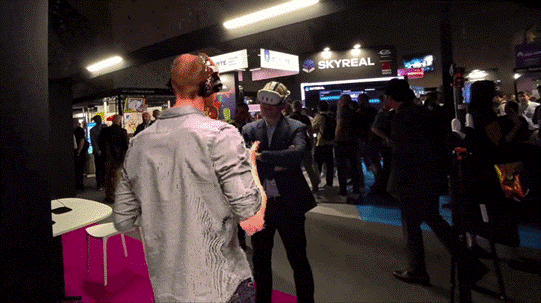
1. Volumetric Video in the Real World: Validation at ISE, MWC, and Laval Virtual
Our efforts have centered primarily on volumetric video technology, a key element in achieving that highly anticipated sense of real “presence.” To validate our progress, we didn’t stay inside the office walls: we brought the technology to users across various sectors and put it to the test in some of the most demanding environments in the world.
Validating and participating in major international events like ISE (Integrated Systems Europe), MWC (Mobile World Congress), and Laval Virtual has been fundamental. These events allowed us to gather direct, high-value feedback on the maturity of the technology, its hardware, and its usability in real-world, high-traffic environments.
2. The Ultimate Deployment Challenge: Eliminating Technical Friction
During this technical validation process with the pilots, we identified a clear obstacle: there was significant friction regarding deployment and usability for end-users. Until recently, setting up a volumetric video system required dealing with a complex ecosystem: multiple computers, a tangle of cables, tripods, standalone cameras, and the unavoidable hardware restrictions of each component. Getting everything up, running, and calibrated took too much time and required advanced technical expertise.
To address this pain point, the VOLUM team decided to take action and design our own line of hardware to eliminate these barriers entirely.
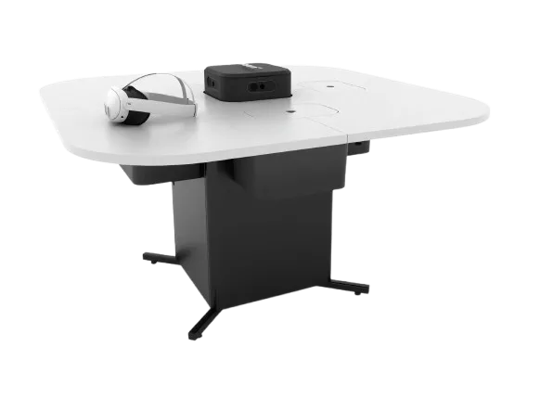
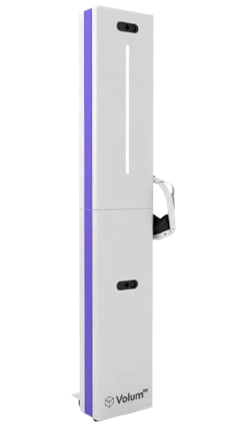
3. The Solution: Welcome to the HoloTotem and HoloTable Era
Our approach to reducing friction for both users and deployers has been to drastically simplify the hardware. We transformed a chaotic setup into a purely plug-and-play experience.
Thanks to solutions like the HoloTotem and HoloTable, users no longer need to worry about connecting cameras or calibrating sensors. These devices natively integrate all the necessary hardware: they come pre-assembled, perfectly calibrated, and ready to use. You just plug them in and start enjoying the volumetric experience.
Conclusion: An Action Plan for Invisible Co-Presence
Technical metrics are important, but human feedback and ease of use are what truly drive technology adoption. Thanks to the insights gathered over these months and the action plan we prepared after identifying these critical points, we are turning the PRESENCE project infrastructure into a solid, commercial, and realistic foundation. We are ready to close out this year knowing we have turned a complex technology into an invisible solution, where the only thing that matters is the connection between people.


