
Part 1 of 2 | July 2026 | Strategy and Insights
At PRESENCE, we are dedicated to redefining the landscape of Extended Reality (XR) through solutions that enhance human-to-human and human-to-machine interactions. Our toolkit enhances the feeling of ‘presence’ in virtual environments, providing a realistic experience across professional collaboration, advanced learning, cultural discovery, and therapeutic interventions.
PRESENCE is driven by a clear-eyed understanding of the challenges and opportunities that these diverse applications present. Through an iterative process of market analysis, expert consultation, and human-centred design, we continuously try to ensure our solutions fit current market dynamics and meet real user needs.
This two-part post shares the market research insights that steer our strategic decisions as of mid-2026, and a lot has changed since our last public market update. In Part 1, we look at where the XR market stands today: the structural shift now underway, and the barriers that continue to shape adoption. In Part 2, we turn to where the market is going and how PRESENCE is responding.
A Market in Structural Shift
The headline from our June 2026 market analysis is not one of stagnation. It is one of bifurcation.
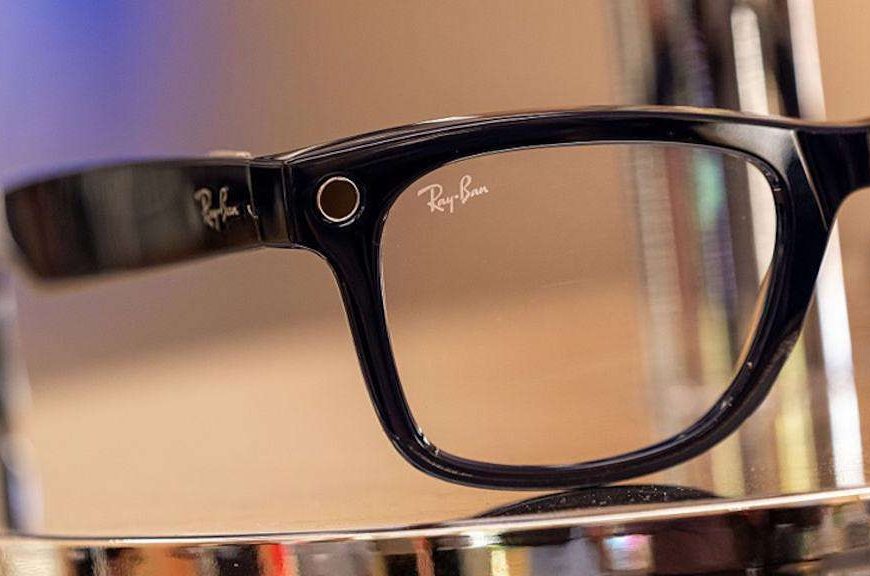
Global XR device shipments grew 44.4% year-on-year in 2025, reaching 14.5 million units (IDC, March 2026). But that growth masks a fundamental split: VR and MR headset shipments declined approximately 43% in 2025, while display-less AI smart glasses surged 247.5%. The near-term growth engine of the XR market is not the headset we imagined. It is a smart glasses frame. Meta and EssilorLuxottica sold over 7 million Ray-Ban Meta glasses in 2025 alone, more than tripling 2023 to 2024 combined sales. Google formally entered the consumer smart glasses market at Google I/O in May 2026, with Intelligent Eyewear powered by Gemini AI and an audio-first, display-free design launching in autumn 2026. Snap has confirmed consumer AR glasses for late 2026. Apple is reportedly targeting a 2027 window.
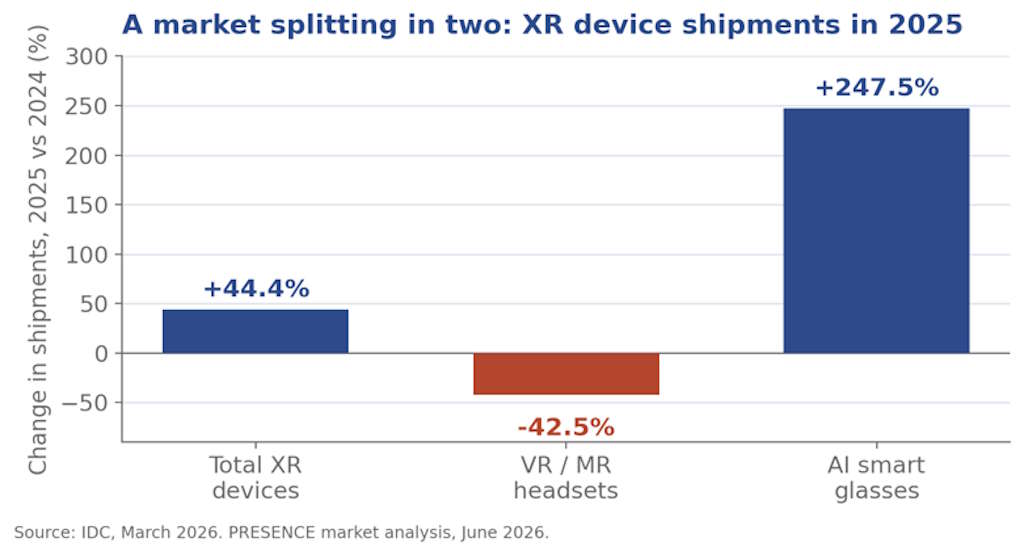
Figure 1. While overall XR shipments grew, headsets fell sharply and AI smart glasses surged. Source: IDC, March 2026.
IDC forecasts further XR device growth of 33.5% in 2026 and a compound annual growth rate of 26.5% through to 2030, reaching approximately 43 million units per year by 2029.
For PRESENCE and its three technology pillars (Holoportation, Haptics, and Intelligent Virtual Humans) this shift matters enormously, though not in the way it might first appear. Smart glasses are not a lightweight substitute for headset-based VR: their small form factor cannot yet support the on-device processing power, display bandwidth, and haptic integration that full volumetric immersion requires. Holoportation and haptic feedback in particular depend on exactly the kind of compute and display capability that headsets provide and glasses, by design, do not. That is why the market is splitting rather than converging. Headsets remain the only viable platform for our core, high-fidelity application domains in enterprise, training, cultural heritage, and healthcare, while glasses open a separate, complementary track for lightweight, audio-first Intelligent Virtual Humans interactions.
Understanding Market Barriers: Updated for 2026
Our understanding of the barriers to XR adoption has deepened since our original analysis, and some of the landscape has changed materially.
Technical Barriers
The quest for realism within XR environments remains paramount. Current VR headsets still face limitations in frame rate, resolution, and haptic accuracy. The ‘uncanny valley’, where near-realistic human likenesses create unease, remains a challenge our Intelligent Virtual Humans pillar is directly designed to address. The lack of a convincing sense of presence continues to be a central barrier to broader adoption.
That said, meaningful technical progress is visible. Meta’s Codec Avatars programme now enables full-body photorealistic avatars running on Quest 3, generated from a short selfie video. Google Beam, the commercial successor to Project Starline, uses a six-camera AI volumetric model at 60 frames per second, enabling photorealistic 3D video calls now rolling out to enterprise early adopters. Three-dimensional Gaussian Splatting has emerged as a key enabling technique for real-time volumetric video at reduced compute cost. These are not incremental improvements; they are the kind of advances that begin to close the realism gap.
Smart glasses introduce new technical constraints of their own: they demand lightweight, on-device AI inference with minimal latency, favouring audio-first interaction over full visual immersion, which is precisely why they cannot yet host the kind of experiences headsets deliver. For Intelligent Virtual Humans in particular, this opens a parallel deployment track alongside headset-based experiences, rather than a path that competes with it.
Economic Barriers
Despite declining hardware costs at the consumer end, enterprise-grade XR hardware remains expensive. SenseGlove Nova 2 haptic gloves cost €6,299 per unit; HaptX Gloves G1 run to approximately $5,495. Development of customised XR software continues to require specialised programming and 3D modelling skills, and SMEs face meaningful cost barriers. Meta raised Quest headset prices in April 2026 following a global memory chip shortage, a reminder that hardware pricing is not on a simple downward trajectory.
The subscription model is beginning to show commercial viability: Meta’s Supernatural fitness subscription passed one million paying subscribers in July 2025, implying approximately $200 million in annualised recurring revenue. This is a useful reference point for PRESENCE..
Societal and Ethical Barriers
Privacy concerns have intensified, not diminished, since our last update. On-device cameras and microphones in always-worn smart glasses raise serious questions about bystander surveillance and data collection that go beyond the VR headset case. Meta and Google have responded with indicator lights and transparency disclosures, but regulatory scrutiny is increasing. European consumers in particular show higher privacy sensitivity than their global counterparts, and this shapes the market PRESENCE operates in.
Consumer VR adoption has effectively plateaued. Gartner analyst Tuong Huy Nguyen summarised the situation in November 2025: “Everyone who wants a VR headset already has one.” Persistent barriers include battery life, immature app ecosystems, device weight, and difficulty demonstrating utility beyond gaming. The PRESENCE approach of demonstrating value in specific, high-stakes use cases like clinical training, professional collaboration, and cultural heritage is the right response to this reality.
Policy and Regulatory Barriers: Significantly Updated
The European regulatory environment changed materially in 2025 and 2026 and now directly affects XR developers.
The European Accessibility Act (EAA) entered into force on 28 June 2025, requiring that consumer electronics and digital services placed on the EU market meet harmonised accessibility standards. XR developers must ensure accessible design, including captions, adjustable interfaces, and compatibility with assistive technologies, as a legal requirement rather than a best practice.
The EU AI Act is being implemented in phases. Prohibited practices and AI literacy obligations applied from February 2025. GPAI model obligations became applicable in August 2025. A political agreement reached in May 2026 (the AI Act Omnibus) will delay high-risk Annex III system compliance to December 2027 and Article 50 transparency obligations to December 2026. Article 50 is directly relevant to PRESENCE’s Intelligent Virtual Humans work: AI-generated content, including synthetic avatars and voices, must be labelled as such.
The General Product Safety Regulation (GPSR), in force since December 2024, applies to XR hardware marketed in the EU.
Taken together, this regulatory stack creates compliance requirements for XR developers, but it also builds the trust framework that long-term mainstream adoption requires. PRESENCE’s commitment to human-centred, responsible XR design is well-aligned with this environment.
Watch This Space For Part 2
In Part 2 of this series, we move from where we are to where we are going. We share our key market insights for mid-2026, covering the European market, the convergence of AI and XR, and what gaming signals for the wider industry. We then set out PRESENCE’s strategic response and the developments we are watching most closely in the months ahead.


