Part 2 of 2 | September 2026 | Strategy and Insights
In Part 1 of this series, we looked at where the XR market stands in 2026: a market in structural shift, with near-term growth moving from headsets toward AI smart glasses, alongside a set of technical, economic, societal, and regulatory barriers that continue to shape adoption. In Part 2, we turn to where the market is going, what it means for PRESENCE, and the developments we are watching most closely.
Several things have moved since Part 1. Europe’s AI Act simplification package is now law, and the transparency obligations that matter most to our work are already in force. EU defence budgets have been revised sharply upward. And Meta has made its clearest strategic break yet from headset-first social VR. Where the picture has changed, we say so.
Key Market Insights: Autumn 2026
The European Market
European XR market estimates still vary widely by research firms, but the structural picture is consistent. The market is predominantly enterprise and services-weighted, with education, healthcare, manufacturing, and arts and cultural heritage as the leading application sectors.
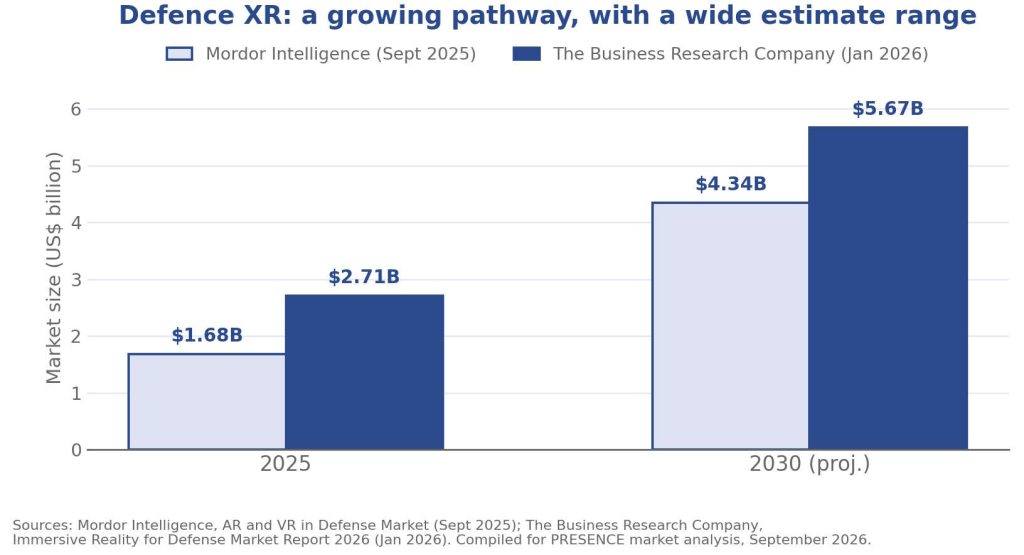
Defence has become a considerably stronger tailwind than it was when we last wrote. The European Defence Agency’s defence data report published in July 2026 puts EU Member State defence expenditure at €418 billion in 2025, up 20% year-on-year, with €547 billion by 2029. Estimates of the defence XR market itself diverge widely. Mordor Intelligence puts it at $1.68 billion in 2025 growing to $4.34 billion by 2030. The Business Research Company puts the 2025 base around 60% higher, at $2.71 billion, reaching $5.67 billion by 2030 on a slower growth rate. Both agree that training and simulation accounts for the largest share, which is precisely where PRESENCE’s training use case helps with.
What might a defence use case look like? Picture combat medics training on lifelike virtual patients that react in real time, or maintenance crews practicing complex repairs with haptic feedback that makes the training feel physical rather than theoretical. Add holoportation to the mix, and instructors could run a session for cadets scattered across different countries as if they were all in the same room, no travel required.
It is not a coincidence that this sounds a lot like PRESENCE’s own manufacturing and training use case. The same combination of virtual humans as instructors, haptics for hands-on realism, and holoportation for remote collaboration that we are validating for industrial training maps directly onto what defence organisations are already investing in.
Worth being upfront about one thing: PRESENCE itself is not building a defence application. Horizon Europe funds only civilian research, so this is not a use case we are pursuing within the project. What it does show is the scale of the opportunity our technology could unlock further down the line, through partners or spin-offs who take these building blocks into new markets after the project ends.
AI and XR Convergence
The integration of AI in XR remains the defining technology narrative, and in 2026 it has begun to reshape the development process itself, not only the end experience. Meta released XR Operator in August 2026, a tool that lets AI agents navigate and test running VR applications inside its XR Simulator, following the agentic workflows added to its Immersive Web SDK in May. Fully embodied
conversational LLM characters, which Meta rolled out to Horizon Worlds creators in late 2025, are becoming table stakes rather than a differentiator. What developers increasingly expect from an SDK is that it fits an AI-assisted workflow.
The research picture is more nuanced than it looked six months ago, with work published in 2026 showing measurable gains from LLM-driven virtual humans in VR learning contexts, mediated by perceived agency and better-structured cognitive load, with small-scale studies reporting good usability while flagging end-to-end response latency of roughly one and a half to three seconds as the practical limit. But a stratified meta-analysis published in Educational Psychology Review in April 2026, covering 26 meta-analyses and 180 primary studies, found that once studies at high risk of bias are set aside, the learning advantage of VR is not statistically reliable. We do not read that as a reason for pessimism. We read it as confirmation that general claims about immersion improving
outcomes will not carry weight, and that value has to be demonstrated in specific, well-designed use cases. That is exactly what the PRESENCE demonstrator-led approach is for. Latency and non-verbal nuance remain open research challenges that our Intelligent Virtual Humans work addresses directly.
Gaming as a Market Signal
Gaming and entertainment remains the largest single XR application segment, but its share is falling: 38.3% of the global market in 2025 on one widely cited estimate, closer to 31% in 2026 on another. The two definitions are not compatible, but the direction is consistent, and enterprise segments, with healthcare among the fastest, are growing more quickly.
The more important signal is what the platform holders are doing. In February 2026 Meta said it would refocus Horizon Worlds almost exclusively on mobile. By August it was reported to be spinning Worlds out of the Horizon mobile app entirely, into a standalone product built around AI-assisted world creation. Analysts disagree about where that leaves the hardware: IDC expects headset shipments to rebound in 2026 after a year of decline, reaching around 21 million units a year by 2029, while Omdia forecasts XR headwear shipments falling a further 12% in 2026 to 6.2 million units, with growth returning only in 2027. The two use different scopes, but neither describes a headset market that is about to expand quickly.
For PRESENCE the headset installed base is not going to grow its way into our use cases. Value has to come from the depth of the experience in high-stakes settings rather than from consumer volume.
Regulation
Regulation is the area that has changed most since Part 1. AI transparency rules already apply: if someone is interacting with an AI system, or seeing synthetic content, that has to be disclosed. Machine-readable marking of AI-generated output follows in December 2026, and accessibility and cyber-security obligations are landing on XR hardware over the same period. That is a lot for small developers to absorb, and in Europe most XR developers are small. But these rules are also what mainstream adoption depends on, and they reward technology that is documented, accessible and transparent by design.
PRESENCE’s Strategic Response
Our understanding of the market in autumn 2026 reinforces rather than undermines PRESENCE’s strategic direction.
Modular, not monolithic. Sound’s market research and user interviews point to modular adoption rather than a single integrated platform. Intelligent Virtual Humans (IVH), developed by UHAM, has the broadest market pull and the lowest integration friction, making it the natural entry point.
Holoportation (i2CAT) and Haptics (SenseGlove) deliver high value in specific settings such as enterprise collaboration and clinical simulation, but are hardware-dependent and therefore situational.
Integration is key, but value is use-case dependent. One of our core findings from the market research and user interviews is that combining our three technology pillars does not automatically create a stronger sense of presence. Value from integration is real, but it is context-dependent. This sharpens our focus on demonstrators: rather than selling a technology bundle, we use specific,
validated use cases to show where integration delivers measurable outcomes.
Developers value ease of use; end users value complete solutions. This shapes how we package and communicate our SDKs. Developers, our primary direct customers, need low-friction integration, good documentation, and tooling that fits their existing workflows. End users in healthcare, training, or cultural heritage need to see outcomes, not components.
That thinking is now built into how we release our work. Our Developer Hub is live, with documentation and integration guidance for teams who want to start building with PRESENCE technologies. If you are working on virtual humans, volumetric capture or haptics and want early access, we would like to hear from you.
What We Are Watching
Smart glasses. Snap, Google, Samsung and Meta all have new devices arriving this autumn. The question for us is when they reach Europe — Meta’s Ray-Ban Display still has not launched here. European availability, not global shipments, is what sets the addressable market for lightweight virtual human applications.
AI content marking. From December 2026, AI-generated output must be marked in a machine-readable format, and immediately for anything newly released. The consortium is deciding whether to align with the EU Code of Practice or document its own approach.
Defence training and simulation. Rising European defence budgets are opening a commercialisation route for immersive training, with new instruments for SMEs expected from early 2027.


