Putting MPEG Haptics to the Test: A User Study by WYVRN on Perceptual Fidelity in PRESENCE
By Detjon Brahimaj, WYVRN
From Standard to Sensation
In earlier posts we described how haptics has become a first-class media type in MPEG, and how PRESENCE adopted the MPEG-I Haptics standard (ISO/IEC 23090-31) as the common language of its Haptics API. Within WP3, SenseGlove, Interhaptics and Actronika built a multi-device reference implementation: device-specific haptic effects are transcoded into the HJIF interchange format, and decoded again for whatever glove, vest or controller the user is wearing.
One question was left open. Encoding always changes the signal. Effects are quantised, resampled and re-described in a common format, so the HJIF file is not numerically identical to the original. A standard is only useful if that change goes unnoticed. If people can feel the difference, “author once, play anywhere” comes at the cost of quality.
So we asked users directly.
The Experiment: Three Cubes and a Simple Question
We built a dedicated test scene in Unity, running on a Meta Quest 3. In each trial the participant stood in front of three cubes:
- the centre cube always played the reference effect from the original Interhaptics .haps file;
- the two side cubes played the same effect twice — once from the original file and once from its HJIF version produced by the PRESENCE Haptics API — with the left/right position randomised on every trial.
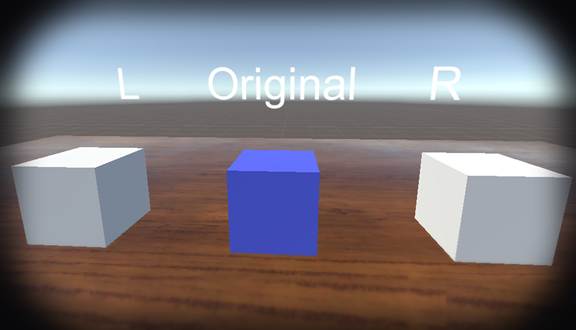
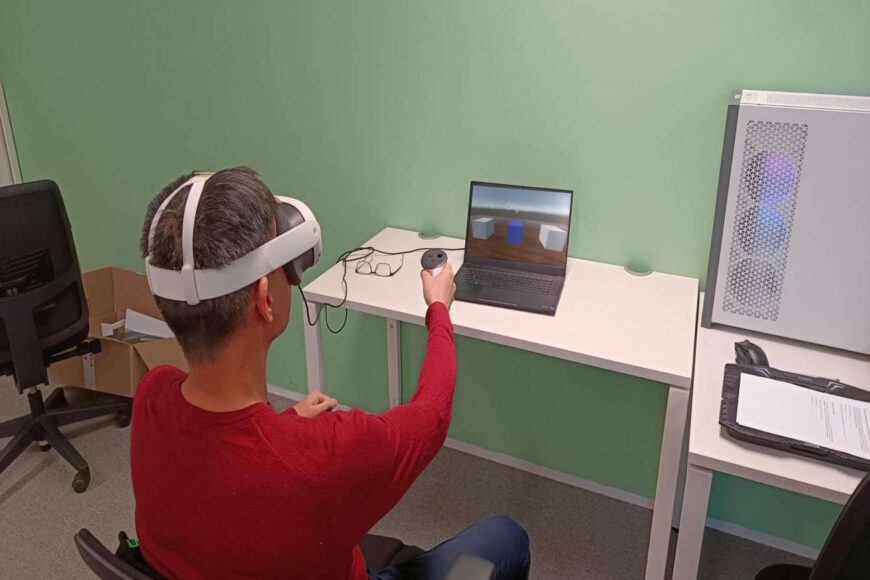
Figure 1 — The test setup. (a) A participant in the controller condition, wearing the Meta Quest 3 headset and holding the Quest 3 controller; the experimenter’s laptop shows the test scene. (b) What the participant sees in VR: the centre cube plays the reference effect; one side cube plays the original file and the other its MPEG-encoded version.
Participants could touch the cubes as often as they liked and then told the experimenter which side cube felt identical to the centre one. If the encoding is perceptually transparent, people cannot tell the two apart and should pick the encoded cube about half the time: a 50 % “confusion rate” is exactly what perfect fidelity looks like.
We tested two very different output devices:
| Device | Haptic technology | Effects tested |
| Meta Quest 3 controller | Vibrotactile actuator in a handheld controller | 12 effects: steady tones, frequency sweeps and staircases, amplitude ramps, button clicks and transient trains |
| SenseGlove haptic glove | Fingertip vibrotactile actuators and force-feedback squeeze | 10 effects: steady tones, a 150–250 Hz sweep, amplitude ramps, 7 ms bursts, a double click and two squeeze effects |
Table 1 — Devices and haptic effects in the study.
Data were collected in three rounds between November 2025 and September 2026: 38 participants completed the controller block, and 27 of them also completed the glove block, for 726 trials in total. The order of the two devices was alternated between participants.
What We Found
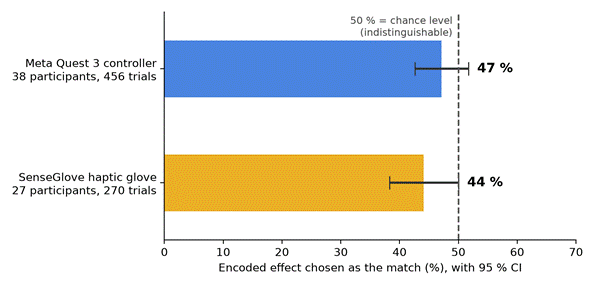
Figure 2 — How often participants picked the encoded effect as the match. The dashed line at 50 % is what you would expect if the two versions were indistinguishable.
On the Meta Quest 3 controller, participants could not tell the encoded effects from the originals. They picked the encoded cube in 47 % of trials, statistically indistinguishable from guessing. Beyond “no significant difference”, the data actively support equivalence: a Bayesian analysis favoured the “pure guessing” explanation by a factor of about 8, and participant accuracy was formally equivalent to chance within a ±10 % margin. The result held across all three data-collection rounds, including an independent round run with the controller only.
On the SenseGlove, the picture is promising but not yet conclusive. The encoded effect was chosen in 44 % of trials. That is close to chance, and the difference did not reach statistical significance, but the data are also not strong enough to rule out a small residual difference.
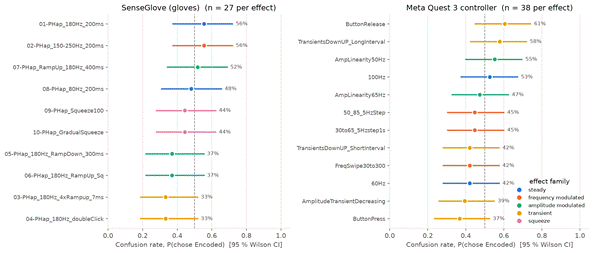
Figure 3 — Confusion rate per haptic effect for the glove (left) and the controller (right), coloured by effect type. No single effect was reliably detectable after correcting for multiple comparisons.
Looking at individual effects, no effect on either device was reliably detectable. On the glove, however, a pattern is worth following up: the two shortest, sharpest effects — a double click and four 7 ms bursts — had the lowest confusion rate (33 %). This is plausible: very short transients and sharp onsets are where any re-encoding with limited temporal resolution would show first. Steady tones, frequency sweeps and squeeze effects showed no sign of a difference.
A few other observations stood out:
- No “golden fingers”. The spread of individual scores matched what pure guessing predicts. No subgroup of participants could consistently spot the encoded version.
- Taking longer did not help. Participants spent around 25 seconds per comparison, but slower, more careful decisions were no more accurate than quick ones.
- No learning within a session. Accuracy did not improve over the course of a block.
Why It Matters
For developers and content creators, the result is good news: haptic effects can be converted into the MPEG standard format and played back on a commercial XR controller without users noticing any loss of quality. Together with the bandwidth figures discussed in our previous post — a few kilobits per second for good-quality haptics — this means standardised haptics can be authored once, streamed alongside audio and video, and rendered across devices.
To our knowledge, this is one of the first user studies to evaluate the perceptual fidelity of the MPEG-I Haptics format on commercial XR hardware. It gives the standard something that specifications alone cannot: evidence that people do not feel the difference.
Conclusion
The findings will feed back into our contributions to the MPEG haptics standardization work, where perceptual evidence of this kind will help set encoding parameters.
With the controller result in hand, the PRESENCE haptics pipeline now has user-validated evidence behind it: touch, encoded with an open standard, still feels the way its creators intended.
Key Takeaways
- Controller: no perceivable difference. Users picked the encoded effect 47 % of the time, equivalent to guessing.
- Glove: close to transparent. 44 % confusion, not significantly different from chance.
- Standards can deliver quality. MPEG-I Haptics enables interoperability without a perceptible cost on commercial XR hardware.
PRESENCE is co-funded by the European Union under Grant Agreement No. 101135025.


